
Complete Solution for Lifescience — Conceptual Mastery Without Rote Note-Taking.
👨🏫 Founder & Chief Mentor (The Guide): Dr. Prem Prakash Asopa
Focused 15-student classroom batches in Jaipur + nationwide Live & Recorded courses, updated printed notes, and daily Part-C analytical MCQ drills.
National Fellowships & Gazette-I Selections
CSIR-NET JRF All-India Rank 4 (AIR-4 — JNU New Delhi)
Direction scholar secured All-India Rank 4 (AIR-4) in CSIR-UGC NET JRF Life Sciences and joined JNU, New Delhi for doctoral research under the mentorship of Dr. Prem Prakash Asopa.
RPSC Assistant Professor Rank 1 & Top State Selections
Direction alumni achieved Rank 1 and multiple permanent selections in RPSC Assistant Professor (Botany & Zoology) examinations.
High-Ratio JRF & Lectureship Selections from Focused 15-Student Batches
Consistent national CSIR-NET JRF and LS selections produced from small 15-student classroom batches in Jaipur without commercial hype.
GATE XL/BT, ICMR-JRF, DBT-BET & State SET Selections
Multi-exam fellowship qualifiers across GATE Life Sciences, ICMR-JRF, DBT-BET, and State Eligibility Tests (Rajasthan, MP, CG).
Daily One-Frame Concept Matrices
First-Principles Visual Memory Hooks & Exam Traps
Enzyme Inhibition Kinetics: Competitive vs. Uncompetitive vs. Non-Competitive
💡 Listen & Visualize Hook: Visualize Competitive as a tug-of-war at the active site (Km rises, Vmax unchanged; lines cross on Y-axis), and Uncompetitive as locking the ES complex (both Km and Vmax drop equally; parallel lines!).
Ramachandran Plot Dihedral Angles (phi, psi) & Secondary Structure Signatures
💡 Listen & Visualize Hook: Picture the 4 quadrants like a clock: Top-Left (Q-II) houses all Beta-sheets and Collagen triple helices; Bottom-Left (Q-III) houses Right-handed Alpha-helices; Top-Right (Q-I) is the rare Left-handed Alpha-helix zone; Glycine wanders everywhere; Proline is locked at phi = -60 deg.
Intracellular Coat Proteins (COPI, COPII, Clathrin) & GTPase Recruitment
💡 Listen & Visualize Hook: Remember 'COP-II goes TWO-ward the Golgi' (ER -> Cis-Golgi via Sar1-GTP), while 'COP-I returns ONE step back' (Golgi -> ER retrograde via Arf1-GTP, rescuing KDEL soluble proteins).
Eukaryotic Cell Cycle Cyclin-CDK Complexes, Wee1/Cdc25 & Checkpoints
💡 Listen & Visualize Hook: Think of CDK1 (Cdc2) as an engine with two keys: CAK turns it ON at Thr-161, Wee1 puts a safety brake on Tyr-15 so cells grow big enough, and Cdc25 phosphatase snaps off the Tyr-15 brake to launch Mitosis!
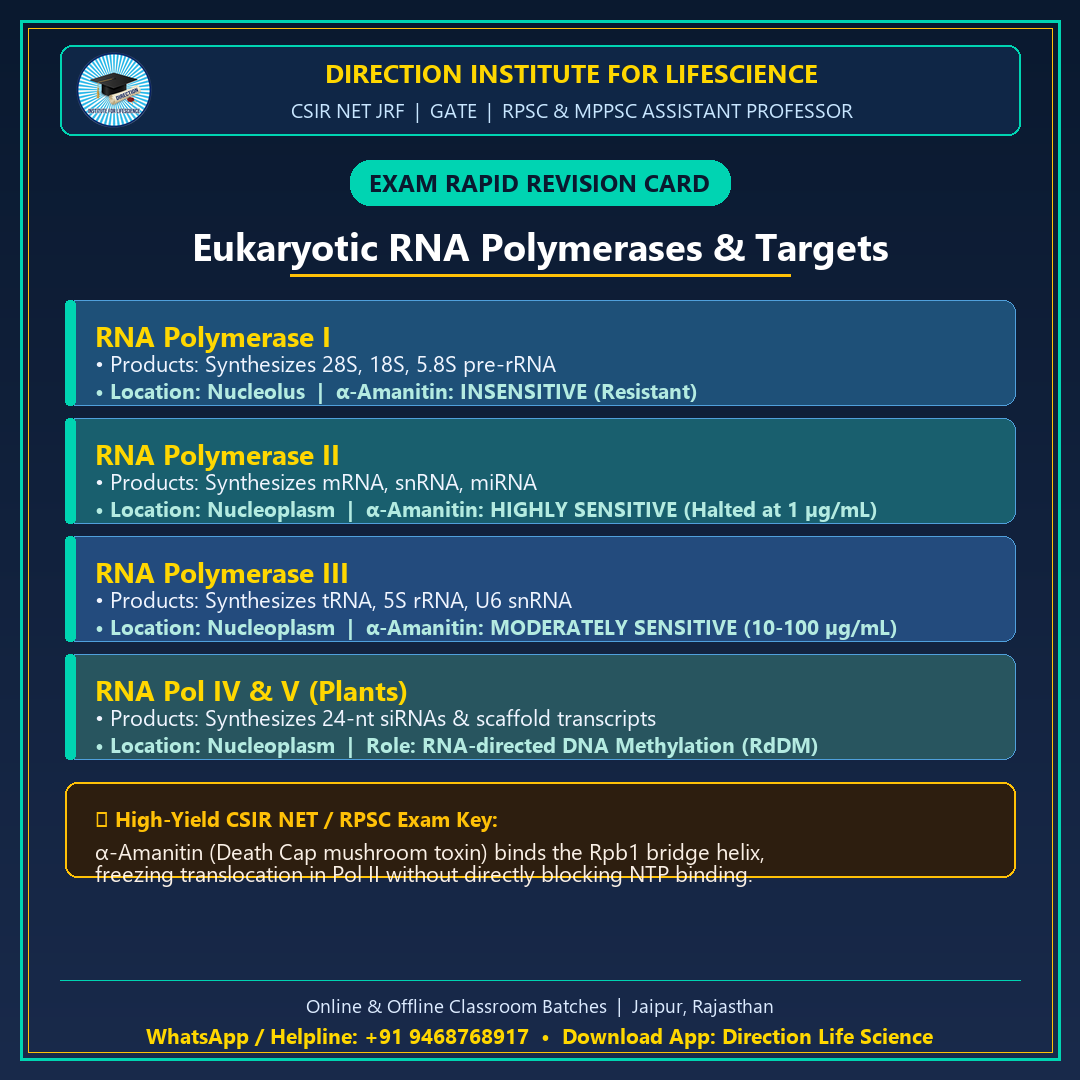
Eukaryotic RNA Polymerases (I, II, III) & alpha-Amanitin Sensitivity
💡 Listen & Visualize Hook: Count 1-2-3 with toxin sensitivity: Pol I (1 = Immune/Insensitive in nucleolus), Pol II (2 = Ultra-sensitive to tiny ng/mL doses, making mRNA), Pol III (3 = Intermediate ug/mL sensitivity, making small tRNAs & 5S rRNA).
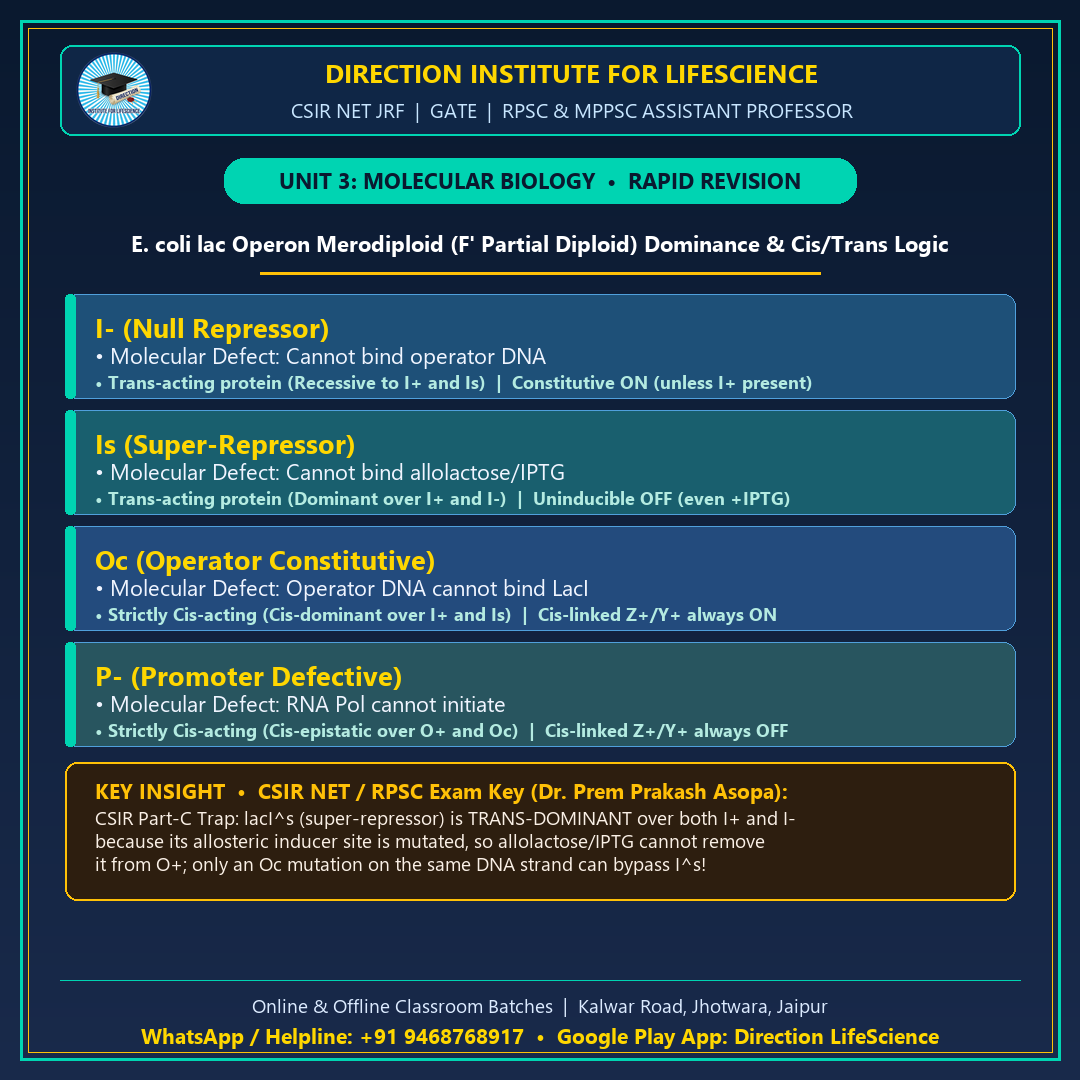
E. coli lac Operon Merodiploid (F' Partial Diploid) Dominance & Cis/Trans Logic
💡 Listen & Visualize Hook: Ask two questions on every F' merodiploid: (1) Is there an Is (super-repressor) anywhere in the cell? If yes, it locks ALL wild-type O+ operators permanently OFF. (2) Is there an Oc (operator-constitutive) attached in cis to a working Z+ or Y+ gene with a working P+ promoter? If yes, that gene stays ON forever!
Comprehensive Preparation Across 6 Major Tracks
CSIR-UGC NET JRF & Lectureship (Life Sciences)
Target Role: Junior Research Fellow (JRF) & Assistant Professor Eligibility
Conducted by: NTA / CSIR HRDG • Part-C Analytical Focus: 100%
Graduate Aptitude Test in Engineering — Life Sciences (XL) & Biotechnology (BT)
Target Role: IISc / IIT Ph.D., M.Tech & PSU Scientist Admission
Conducted by: IITs / IISc • Part-C Analytical Focus: 90%
ICMR JRF & DBT-JRF Biotechnology Eligibility Test (BET)
Target Role: Biomedical & Biotechnology Doctoral Research Fellowship
Conducted by: ICMR / RCB-DBT • Part-C Analytical Focus: 85%
State Eligibility Test (Rajasthan SET, MH-SET, GSET, WBSET — Life Sciences)
Target Role: State University & College Assistant Professor Eligibility
Conducted by: State Nodal Universities /SLET Commission • Part-C Analytical Focus: 75%
RPSC / UPHESC / MPPSC / HPSC Assistant Professor (Botany & Zoology)
Target Role: Permanent Gazette-I College Cadre Assistant Professor
Conducted by: State Public Service Commissions (RPSC / PSCs) • Part-C Analytical Focus: 80%
IIT-JAM Biotechnology & Central University M.Sc. Life Science Entrances
Target Role: Integrated Ph.D. & M.Sc. at IISc, IITs, JNU, DU, BHU
Conducted by: IITs / NTA • Part-C Analytical Focus: 70%
All 13 Official Life Science Syllabus Units Covered
Molecules and their Interaction Relevant to Biology
📖 Primary Reference: Lehninger Principles of Biochemistry
Cellular Organization
📖 Primary Reference: Alberts Molecular Biology of the Cell
Fundamental Processes
📖 Primary Reference: Watson Molecular Biology of the Gene / Lodish
Cell Communication and Cell Signaling
📖 Primary Reference: Kuby Immunology & Alberts Signaling
Developmental Biology
📖 Primary Reference: Gilbert Developmental Biology
System Physiology — Plant
📖 Primary Reference: Taiz & Zeiger Plant Physiology
System Physiology — Animal
📖 Primary Reference: Guyton & Hall Medical Physiology
Inheritance Biology
📖 Primary Reference: Snustad & Simmons Principles of Genetics
Diversity of Life Forms
📖 Primary Reference: Simpson Plant Systematics & Kardong Vertebrates
Ecological Principles
📖 Primary Reference: Odum & Smith Elements of Ecology
Evolution and Behaviour
📖 Primary Reference: Futuyma Evolution
Applied Biology
📖 Primary Reference: Primrose & Twyman Gene Manipulation
Methods in Biology
📖 Primary Reference: Wilson & Walker Principles and Techniques of Biochemistry